
PUBLICATIONS AND VIDEOS
Technical Note 15
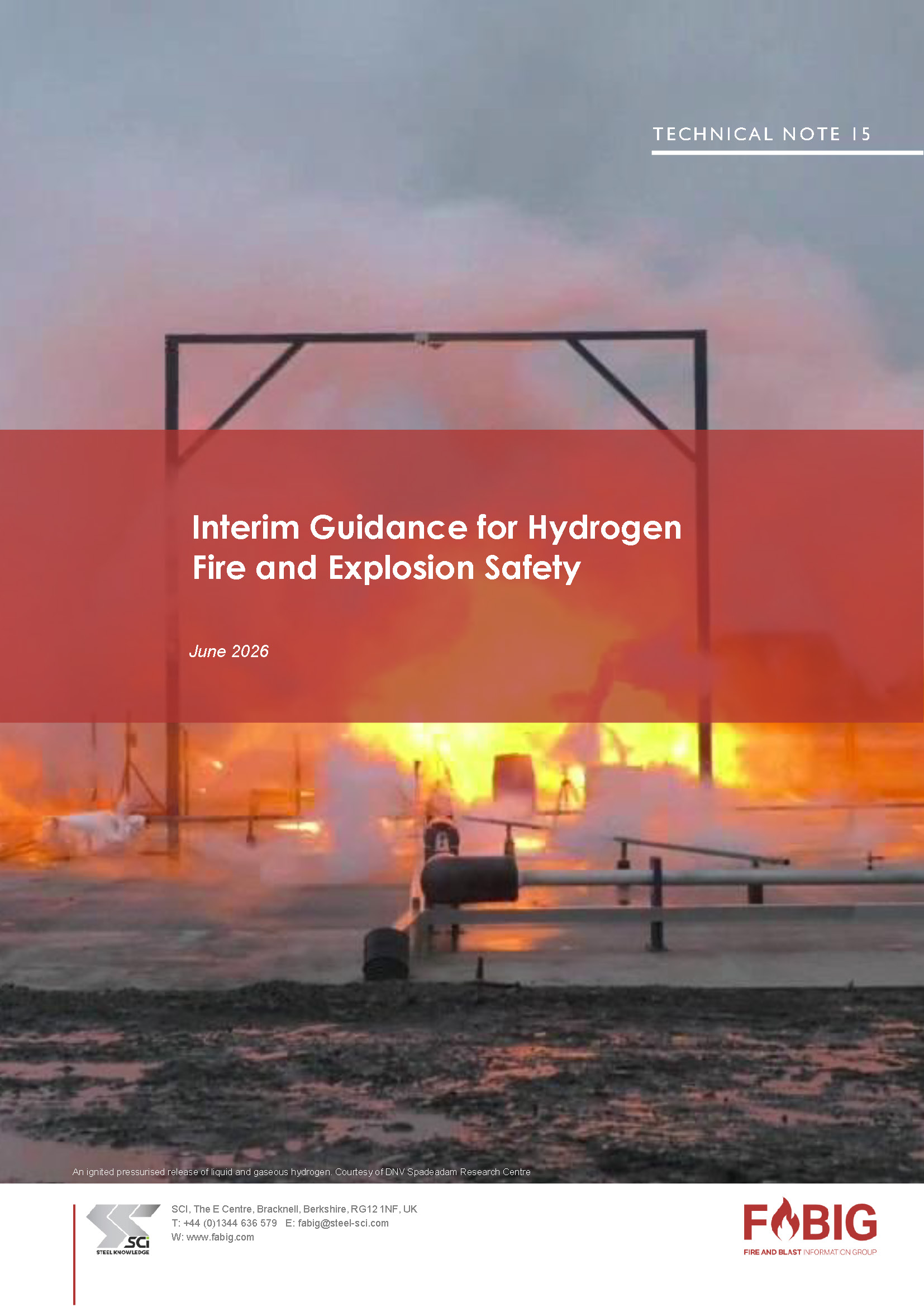
Interim Guidance for Hydrogen Fire and Explosion Safety
FABIG Members: Log-in to access all FABIG resources LOG IN
SUMMARY
This Technical Note explains the hazards of hydrogen, provides where appropriate a comparison of these hazards with those of commonly used hydrocarbon fuels, and provides interim guidance on the management of hydrogen project risks and on the modelling of hydrogen releases based on the current state of knowledge. Although it predominantly addresses the hazards of pure hydrogen, the guidance may be applicable to systems with high proportions of hydrogen with appropriate engineering judgement. The document includes some guidance for hydrogen combined with oxygen, but as this is an evolving field, especially for electrolyser technologies, information in this interim guidance may be limited at the time of release. There will hence be a need to update this guidance as more information becomes available. To this end, the final section of this Technical Note describes some of the areas of uncertainty where current and future research should lead to further refinement and extension of the guidance.
TABLE OF CONTENTS
FOREWORD
CONTENTS
- INTRODUCTION
- Background
- Scope
- HYDROGEN SYSTEMS
- H2 production
- H2 as an industrial gas
- H2 applications
- LH2 applications
- Transportation and distribution of H2
- H2 storage
- HAZARDS OF H2 AND LH2
- Properties of H2 that can lead to fire and/or explosion hazards
- Properties of LH2 that can lead to fire and/or explosion hazards
- MANAGING RISKS IN H2 PROJECTS
- Main risk drivers for H2
- Potential for escalation
- H2 production projects
- H2 storage and distribution
- Use of H2 in transport
- MANAGING RISKS IN LH2 PROJECTS
- Main risk drivers for LH2
- Potential for escalation
- LH2 production projects
- LH2 storage and distribution
- LH2 in transport
- MODELLING H2 AND LH2 RELEASES
- Source terms
- Dispersion
- Ignition probability
- Jet fire modelling
- Explosion modelling
- Risk assessment tools
- Consequence analysis tools
- REGULATIONS, CODES AND STANDARDS
- UNCERTAINTIES AND FUTURE DIRECTIONS
- REFERENCES
- APPENDIX A REGULATIONS, CODES AND STANDARDS FOR HYDROGEN SAFETY
Online purchase options:
Non-Members of FABIG are able to purchase PDF copies of the FABIG Technical Guidance documents.